Mammoth Tooth & Mammoth Ivory Knife Handles: Why They Are a Premium Choice for Custom and Collectible Knives
09.02.2026
When it comes to a truly exceptional custom knife, the blade is only part of the story.
A high-end Damascus blade, a rare powder steel, or a beautifully forged multi-layer laminate can make a knife remarkable. But the handle plays an equally important role in the overall character and value of the finished piece.
This is why custom knife makers and collectors often look beyond modern synthetic materials and choose rare natural materials for premium knife handles.
Among the most distinctive options is mammoth tooth and mammoth ivory.
A stabilized mammoth tooth knife handle is more than an attractive piece of natural material. It is made from an ancient fossil that may have remained preserved in permafrost or other deposits for thousands of years before being discovered and transformed into a modern custom knife.
The result is something that combines craftsmanship, natural beauty, rarity, and history in a single object.
Why Do Custom Knives Use Mammoth Tooth and Mammoth Ivory?
There is a simple reason premium custom knives often use rare natural materials:
A premium blade deserves a premium handle.
Imagine a custom knife featuring an intricate Damascus steel blade. The Damascus pattern is the result of careful forging, layering, grinding, polishing, and etching.
Now imagine pairing that blade with a completely ordinary mass-produced plastic handle.
The knife may still be functional, but visually, something is missing.
The handle should complement the blade.
This is where mammoth tooth for knife handles becomes especially interesting.
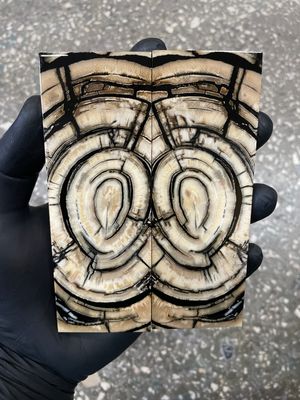
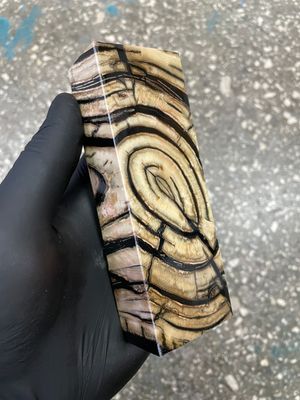
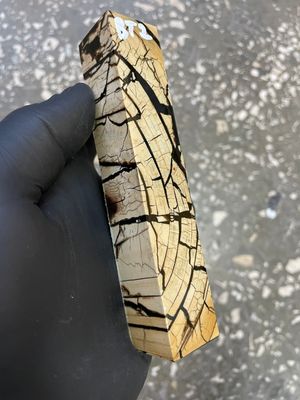
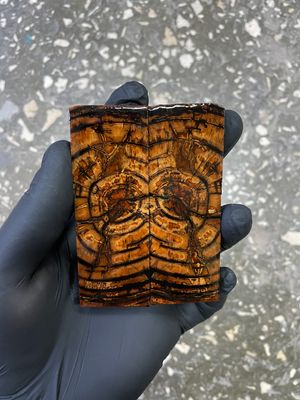
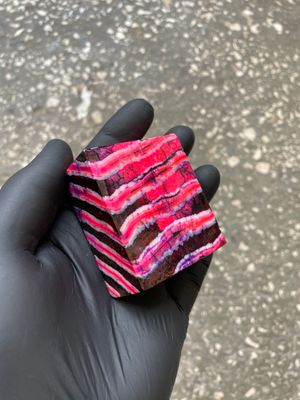
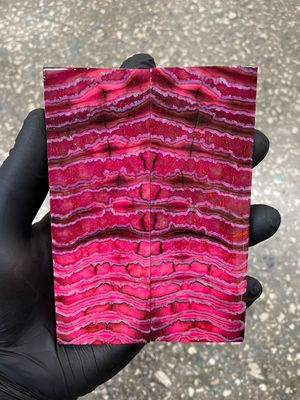
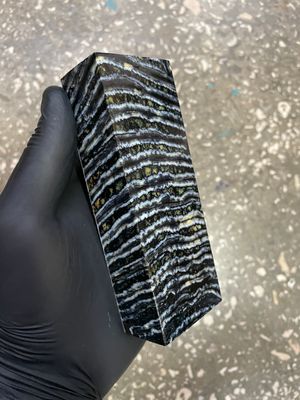
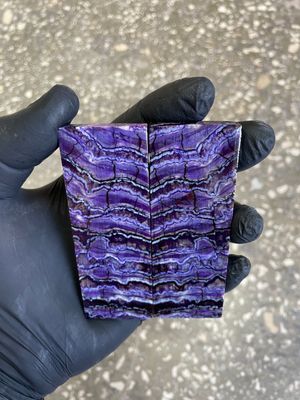
Mammoth tooth has its own natural pattern, color variations, layers, and mineralization. No manufacturer designed that pattern, and no two pieces are exactly alike.
When paired with Damascus steel, the result combines two completely different types of pattern:
The pattern created by the bladesmith and the pattern created by nature.
That contrast is one of the reasons mammoth tooth and Damascus knives are so popular among collectors and custom knife enthusiasts.
Premium Steel Deserves a Premium Handle
Modern knife steels can be extraordinarily expensive.
Custom makers may spend considerable time working with Damascus steel, high-end tool steels, stainless powder steels, or other specialized materials.
The handle becomes part of the presentation.
Natural materials such as mammoth tooth, mammoth tusk, stabilized wood, burl, and other rare materials allow the maker to create a knife that looks like a one-of-a-kind piece rather than a mass-produced product.
The goal is not simply to make a knife that works.
The goal is to create a knife that people remember.
A beautifully patterned Damascus blade combined with a unique piece of stabilized mammoth tooth can create exactly that effect.
Why Not Use G10 or Plastic on a Premium Custom Knife?
G10, micarta, carbon fiber, and modern polymers are excellent knife handle materials.
They are strong, predictable, dimensionally stable, and available in consistent colors and patterns. For hard-use knives and production knives, these characteristics are major advantages.
But there is an important difference between a production knife and a collectible custom knife.
Production materials are designed for consistency.
Natural materials are valued for individuality.
A manufacturer can produce hundreds or thousands of G10 handle scales with nearly identical appearance.
That is exactly what makes G10 useful for production.
Mammoth tooth is the opposite.
A particular piece may contain a completely different pattern from the next piece. Even two handle scales cut from the same section can reveal different natural details after cutting and polishing.
For a mass-produced knife, consistency is valuable.
For a one-of-a-kind custom knife, uniqueness is valuable.
That is why materials such as mammoth tooth and mammoth ivory occupy a very different place in the knife-making world from G10 or injection-molded plastics.
What Makes Mammoth Tooth a Premium Knife Handle Material?
Mammoth tooth is considered a premium material for several reasons.
1. It is rare
Mammoths are extinct.
Modern mammoth ivory and mammoth tooth come from fossil remains rather than from living animals.
There is no modern production of mammoth material.
2. It is non-renewable
A new mammoth cannot grow another tooth or tusk.
Every piece available today comes from material that already existed in the ground.
Once a particular fossil fragment is cut into knife scales, that exact piece is gone forever.
3. It is extremely old
Mammoth remains can be thousands or tens of thousands of years old.
GIA has documented mammoth ivory recovered from Alaska that is at least 10,000 years old.
This gives mammoth material something that synthetic materials simply cannot have:
a prehistoric history.
4. Every piece is different
Natural variation is one of the most desirable characteristics of mammoth tooth.
The material may display cream, brown, gray, golden, or darker areas, along with natural lines, layers, mineralization, and other patterns.
After cutting and polishing, the internal structure can become surprisingly complex.
There is no factory pattern.
Nature made it.
Where Is Mammoth Tooth and Mammoth Ivory Found?
Most commercially known mammoth material comes from northern regions where the remains were preserved by favorable geological and climatic conditions.
Important sources include Siberia and Alaska.
Permafrost plays an especially important role.
When mammoth remains became buried in permanently frozen ground, the cold environment helped preserve them for thousands of years.
As permafrost melts and landscapes change, previously buried remains can become exposed.
River erosion is another important factor.
A river constantly changes its banks and can remove layers of soil and sediment. Flooding and erosion can expose ancient bones, teeth, and tusks that had remained underground for thousands of years.
Some fossil material is also recovered from river deposits and other areas where ancient remains have accumulated.
GIA has documented mammoth ivory discoveries in Alaska, including material exposed through erosion and recovered from areas associated with mining and coastal deposits.
Finding a Mammoth Tusk Does Not Mean Finding Good Knife Material
This is an important distinction.
Finding a mammoth tusk is one thing.
Finding a high-quality mammoth tusk suitable for custom knife handles is something completely different.
Fossil material can be heavily cracked, fractured, porous, mineralized, or otherwise damaged.
Thousands of years underground can leave a significant impact on the material.
Some pieces may be unsuitable for cutting knife scales at all.
Others may contain only small sections that are suitable for premium knife-making applications.
This is one reason high-quality mammoth material can be difficult to source.
A large tusk is not automatically a valuable tusk.
The condition, structure, color, pattern, size, and usable sections all matter.
Why Searching for Mammoth Material Can Take Months
The search for mammoth remains is not comparable to ordering a conventional raw material from a manufacturer.
There is no factory producing new mammoth ivory.
There is no guaranteed supply of identical pieces.
Fossil hunters may work in remote areas where geological conditions make searching difficult and physically demanding.
A particular area may contain mammoth remains — or it may contain nothing suitable at all.
Even when remains are found, the material may be too damaged to become useful knife stock.
This uncertainty is part of what makes high-quality fossil material rare.
The most desirable pieces combine:
• excellent preservation
• attractive natural pattern
• useful dimensions
• limited cracking
• suitable density
• good color
• and enough usable material to produce knife scales or blocks
For a custom knife maker, finding exactly the right piece can therefore be much more important than simply finding "mammoth ivory."
Mammoth Tooth vs. Mammoth Tusk
The terms are sometimes used interchangeably, but mammoth tooth and mammoth tusk are different materials.
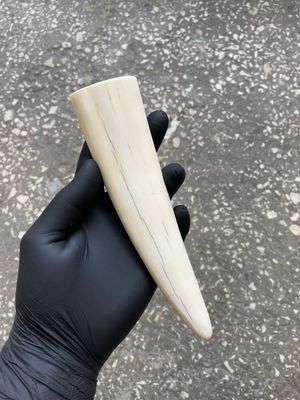
Mammoth Tooth
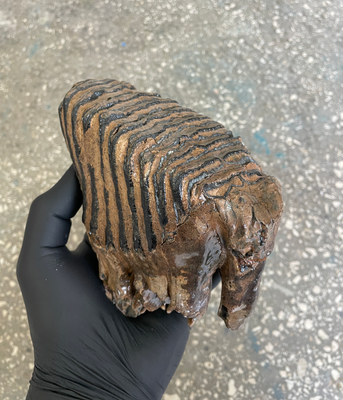
Mammoth tooth is particularly popular for custom knife handles because of its highly distinctive internal structure.
Once cut and polished, the tooth can reveal intricate natural patterns and color variation.
Some pieces have dramatic contrasts, while others have subtle cream, brown, gray, or golden tones.
Mammoth Tusk
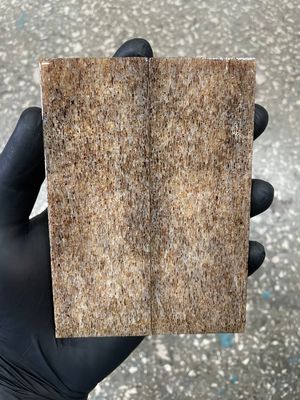
Mammoth tusk is fossil ivory.
It generally has a different structure and visual appearance from mammoth tooth.
Depending on the section of the tusk, the material can display beautiful grain, color variation, and mineralization.
Both can be excellent choices for premium knife handles, but they create very different visual effects.
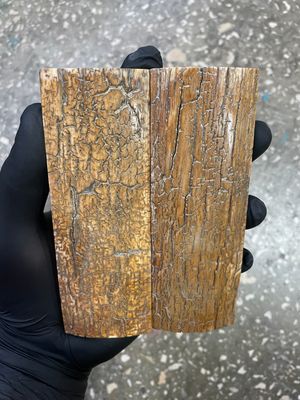
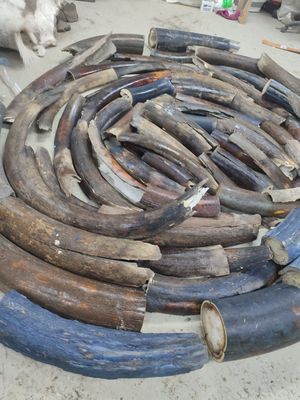
Mammoth Tusk Bark
The outer portion of a mammoth tusk is commonly referred to as the bark or cortex.
This material can retain a distinctive dark, textured appearance.
For knife makers looking for something particularly natural and primitive-looking, mammoth tusk bark can create a striking handle.
Why Is Stabilized Mammoth Tooth Used for Knife Handles?
Fossil material is ancient, and its condition varies considerably from piece to piece.
Some mammoth tooth and ivory can contain pores, microcracks, or weakened areas.
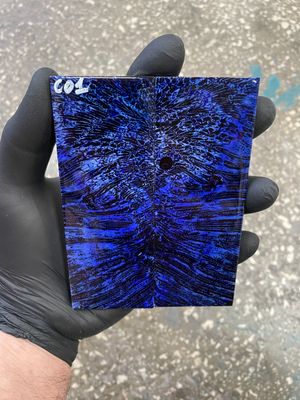
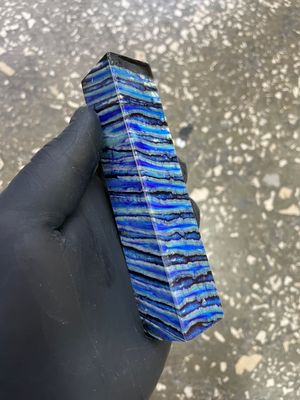
Stabilization is used to improve the structural integrity and workability of suitable fossil material.
During stabilization, a resin is introduced into the material and cured. The resin helps reinforce porous or weakened areas while allowing the original fossil structure and appearance to remain visible.
For knife makers, stabilized mammoth tooth offers several advantages.
It can make the material more predictable to machine, grind, sand, and polish while helping preserve the natural appearance that makes mammoth tooth desirable in the first place.
Stabilized fossil ivory is also commercially available specifically for knife handles and other high-end applications.
Can You Use Mammoth Tooth Without Stabilization?
In some cases, yes.
The condition of fossil material varies considerably. Dense, well-preserved sections may sometimes be suitable for use without extensive stabilization.
However, stabilization can be particularly valuable when working with material containing porosity, microcracks, or other structural weaknesses.
For a custom knife maker investing significant time in a one-of-a-kind knife, the goal is to make the material as predictable and reliable as possible.
The decision ultimately depends on the specific piece and its condition.
Why Does Mammoth Tooth Look So Good with Damascus Steel?
This is one of the most popular combinations in the custom knife world.
Damascus steel and mammoth tooth both have unique patterns — but for completely different reasons.
The Damascus pattern is created by the bladesmith.
The mammoth tooth pattern was created by nature.
The maker controls the steel.
The maker does not control the fossil.
That creates an interesting visual relationship between the blade and handle.
A dramatic Damascus pattern can be paired with a naturally complex mammoth tooth handle without making the knife look repetitive.
Instead, the two materials complement each other.
This is one reason mammoth tooth Damascus knives are so attractive to collectors.
A Natural Material That Cannot Be Reproduced
One of the most important differences between mammoth tooth and synthetic knife handle materials is simple:
You cannot manufacture another mammoth tooth.
You can produce another sheet of G10.
You can mold another polymer handle.
You can manufacture another carbon fiber scale.
But you cannot manufacture another fossil tooth that spent thousands of years buried in the Arctic.
That scarcity gives mammoth material a very different character.
When a particular piece is used for a knife, the finished knife contains something genuinely irreplaceable.
Every Mammoth Tooth Knife Handle Is Different
This is particularly important for collectors.
A collector is rarely looking for something that looks exactly like thousands of other knives.
The attraction of a custom knife is individuality.
The same is true for natural handle materials.
A particular mammoth tooth may contain a unique combination of:
• natural lines
• color transitions
• mineralization
• cracks and healed structures
• texture
• density variations
• and internal patterns
Once the material is cut and polished, these characteristics become part of the finished handle.
The result is a knife that cannot be duplicated exactly.
Can Two Mammoth Tooth Scales Have a Matching Pattern?
Yes.
A suitable section of mammoth tooth can sometimes be cut to produce a pair of knife scales with complementary or mirrored patterns.
This is highly desirable for custom knife makers.
However, natural materials rarely produce perfectly identical surfaces.
That is part of their appeal.
A matched pair should complement each other rather than look like two pieces of synthetic material produced from the same mold.
For premium custom knives, the natural variation is often considered a feature rather than a flaw.
When Did Mammoth Tooth Become Popular in Custom Knifemaking?
It is difficult to identify a single "first" knife made with mammoth tooth.
Fossil ivory had been used for decorative objects before it became a recognizable material category in modern custom knifemaking.
By the early 2000s, mammoth ivory and mammoth tooth were already appearing in the custom knife market.
By 2007, specialist knife literature was describing mammoth tooth as an increasingly popular material for knife handles. Historical knife-industry material from that period describes mammoth tooth as an emerging trend among makers and collectors.
Since then, mammoth tooth and mammoth ivory have become established materials within the world of custom knives, art knives, and collectible knives.
So while the material is prehistoric, its role in modern premium knifemaking is relatively recent.
Why Is a Mammoth Knife More Than Just a Tool?
A production knife is generally evaluated by its performance.
A collectible knife is evaluated differently.
Collectors may care about:
• the maker
• blade steel
• forging technique
• Damascus pattern
• fit and finish
• design
• rarity
• materials
• provenance
• and uniqueness
Mammoth tooth fits naturally into this world.
It gives the maker something that cannot be mass-produced and gives the collector something that cannot simply be replaced.
The handle becomes part of the story of the knife.
A Piece of Prehistoric History in Your Hand
There is another reason people become fascinated by mammoth knife handles.
It is not technical.
It is emotional.
When you tell someone that the handle of a knife is made from mammoth tooth, the reaction is often immediate:
"That's real mammoth?"
The question makes sense.
The material may have existed thousands of years before modern civilization.
A mammoth once carried that tooth.
The animal died.
The remains became buried.
The surrounding environment preserved the material.
Thousands of years passed.
Eventually, someone discovered the fossil.
A craftsman cut and polished it.
And now that ancient material is part of a modern custom knife.
That is something plastic simply cannot provide.
Why Does Mammoth Tooth Add Status to a Custom Knife?
A premium knife is often about more than performance.
It is about craftsmanship, rarity, materials, and the story behind the object.
A knife with a mammoth ivory knife handle immediately communicates that the maker chose something unusual rather than simply selecting the easiest or cheapest handle material.
When the mammoth material is combined with a high-end Damascus blade, premium steel, hand finishing, and custom construction, the result can become a true collector's piece.
It is not just another knife.
It is a unique combination of ancient natural material and modern craftsmanship.
Mammoth Tooth and Damascus: Two Kinds of History
Perhaps the best way to understand the appeal of this combination is to look at what each material represents.
Damascus steel represents human skill.
Its pattern is deliberately created through forging and manipulation of different steels.
Mammoth tooth represents natural history.
Its pattern developed through biological structure, burial, geological processes, mineralization, and thousands of years of preservation.
Put them together and you get something extraordinary:
Ancient natural history in the handle and modern craftsmanship in the blade.
That is exactly the kind of combination that belongs on a collectible custom knife.
From the Ice Age to a Custom Knife
Thousands of years ago, mammoths lived across the northern regions of the world.
After their deaths, some remains became buried and were preserved by frozen ground and other geological conditions.
Today, erosion, thawing permafrost, river activity, and other natural processes can expose material that has remained hidden for thousands of years.
A fossil hunter discovers it.
A specialist prepares it.
A stabilizer may reinforce it.
A knife maker cuts, shapes, sands, and polishes it.
And eventually, a small piece of prehistoric history becomes part of a modern custom knife.
That is what makes mammoth tooth knife scales so fascinating.
They are not simply another handle material.
They are a connection between the prehistoric world and modern craftsmanship.
Why Mammoth Tooth Is a Premium Choice for Custom Knife Handles
When all of these factors are considered together, the appeal becomes clear.
Rarity.
Mammoth material comes from fossil remains of an extinct animal.
Age.
The material may have been preserved for thousands or tens of thousands of years.
Uniqueness.
Every natural piece has its own structure and appearance.
Non-renewability.
There is no modern source producing new mammoth teeth or tusks.
Beauty.
The natural patterns can be exceptionally striking after cutting and polishing.
Compatibility with premium blades.
Mammoth tooth pairs beautifully with Damascus steel, high-end steels, and other premium knife materials.
Collectibility.
A unique fossil handle can turn an already exceptional knife into something truly individual.
Most importantly, mammoth tooth offers something that modern synthetic materials cannot:
a story.
A piece of ancient material that has survived for thousands of years can become part of an object that may itself be preserved for generations.
That is the real appeal of a mammoth tooth knife handle.
It is not just a handle.
It is a piece of history.
Frequently Asked Questions About Mammoth Tooth Knife Handles
What is mammoth tooth used for?
Mammoth tooth is used for a variety of decorative and high-end applications, including custom knife handles, knife scales, jewelry, and collectible objects.
For knife makers, its unique natural pattern makes it particularly attractive for one-of-a-kind and premium custom knives.
What is the difference between mammoth tooth and mammoth ivory?
Mammoth tooth and mammoth ivory are related but different fossil materials.
Mammoth tooth comes from the animal's teeth, while mammoth ivory generally refers to fossil mammoth tusk material.
They have different structures and visual characteristics, making them suitable for different design preferences.
How old is mammoth ivory?
Mammoth ivory can be thousands or tens of thousands of years old.
Individual specimens vary, but documented mammoth ivory from Alaska has been dated to at least 10,000 years old.
Is mammoth ivory real ivory?
Yes.
Mammoth ivory is genuine fossil ivory from extinct mammoths.
It is fundamentally different from modern elephant ivory because it comes from animals that died thousands of years ago rather than from living or recently deceased elephants.
Is mammoth tooth good for knife handles?
Yes.
Well-preserved and properly prepared mammoth tooth can be an excellent material for custom knife handles and knife scales.
Stabilization can be used when appropriate to reinforce porous or weakened material.
Does mammoth tooth need to be stabilized?
Not necessarily.
Some well-preserved material can be used without stabilization. However, stabilization is often preferred for knife-making stock when the material contains porosity, microcracks, or other structural weaknesses.
The decision depends on the individual piece.
What is stabilized mammoth tooth?
Stabilized mammoth tooth is genuine fossil mammoth tooth that has been treated with resin to reinforce its structure.
The stabilization process can improve the material's workability and stability while preserving its natural appearance.
Why is stabilized mammoth tooth popular with knife makers?
Because it combines the unique appearance of natural fossil material with improved structural characteristics for knife making.
It can be easier and more predictable to grind, shape, sand, and polish than a fragile untreated fossil.
Is mammoth tooth good with Damascus steel?
Absolutely.
Mammoth tooth and Damascus steel are one of the most visually appealing combinations for custom knives.
The handcrafted pattern of Damascus contrasts beautifully with the naturally occurring pattern of mammoth tooth.
Why is mammoth tooth expensive?
Several factors influence its price.
High-quality mammoth tooth is rare, non-renewable, difficult to source, and highly variable in quality.
Size, color, pattern, condition, mineralization, stabilization, and the amount of usable material all affect the value of a particular piece.
Is mammoth tooth renewable?
No.
Mammoths are extinct, so no new mammoth teeth or tusks are being produced.
Modern mammoth material comes from fossil remains that have survived in the ground for thousands of years.
Where is mammoth ivory found?
Significant fossil mammoth material has been recovered from northern regions including Siberia and Alaska.
It can be found in permafrost, soil deposits, river sediments, coastal areas, and other geological environments where mammoth remains were preserved.
Can mammoth tusks be found in rivers?
Yes.
River erosion can expose ancient fossil material, and mammoth remains can also occur in river deposits.
However, the location and quality of recoverable material vary considerably depending on local geology and environmental conditions.
Is mammoth tooth better than G10 for a knife handle?
Neither material is universally "better."
G10 is excellent for hard-use and production knives because it is strong, consistent, and predictable.
Mammoth tooth is chosen primarily for custom, collectible, and premium knives because of its rarity and unique natural appearance.
The right material depends on the purpose of the knife.
Can you polish mammoth tooth?
Yes.
Properly prepared mammoth tooth can be ground, sanded, and polished to produce a smooth, attractive surface that reveals the natural structure and colors of the fossil.
Can mammoth tooth be used for knife scales?
Yes.
Mammoth tooth is commonly prepared and sold as knife scales and knife-making blocks.
The usable size and suitability depend on the condition and dimensions of the individual fossil.
Can two mammoth tooth knife scales match?
Yes.
A suitable piece can sometimes be cut to produce a matched pair of knife scales with complementary or mirrored patterns.
However, because mammoth tooth is a natural material, some variation between the two scales is normal and often desirable.
When did mammoth tooth become popular for custom knives?
Mammoth ivory was already being used in the custom knife market by the early 2000s, and by 2007 specialist knife publications were describing mammoth tooth as an increasingly popular handle material.
It has since become an established choice for custom knives, art knives, and collectible knives.
Why do collectors like mammoth knife handles?
Collectors value uniqueness.
A mammoth tooth or mammoth ivory handle can give a knife a one-of-a-kind appearance while adding a fascinating historical element.
Instead of simply being a functional component, the handle becomes part of the story and identity of the knife.
Is a mammoth tooth knife handle a good choice for a collectible knife?
For the right design, absolutely.
Mammoth tooth works particularly well when the goal is to create a knife that emphasizes rarity, craftsmanship, natural materials, and individuality.
Combined with Damascus steel or another premium blade steel, it can create a knife that is both functional and collectible.
What makes a mammoth tooth knife special?
The answer is simple:
No two pieces are exactly alike, and the material itself is thousands of years old.
A custom knife made with mammoth tooth combines modern craftsmanship with a natural material that survived from the prehistoric world.
That is something no synthetic handle material can truly replicate.